Factories & Manufacturers
How to Get Manufacturing Leads Without Trade Shows
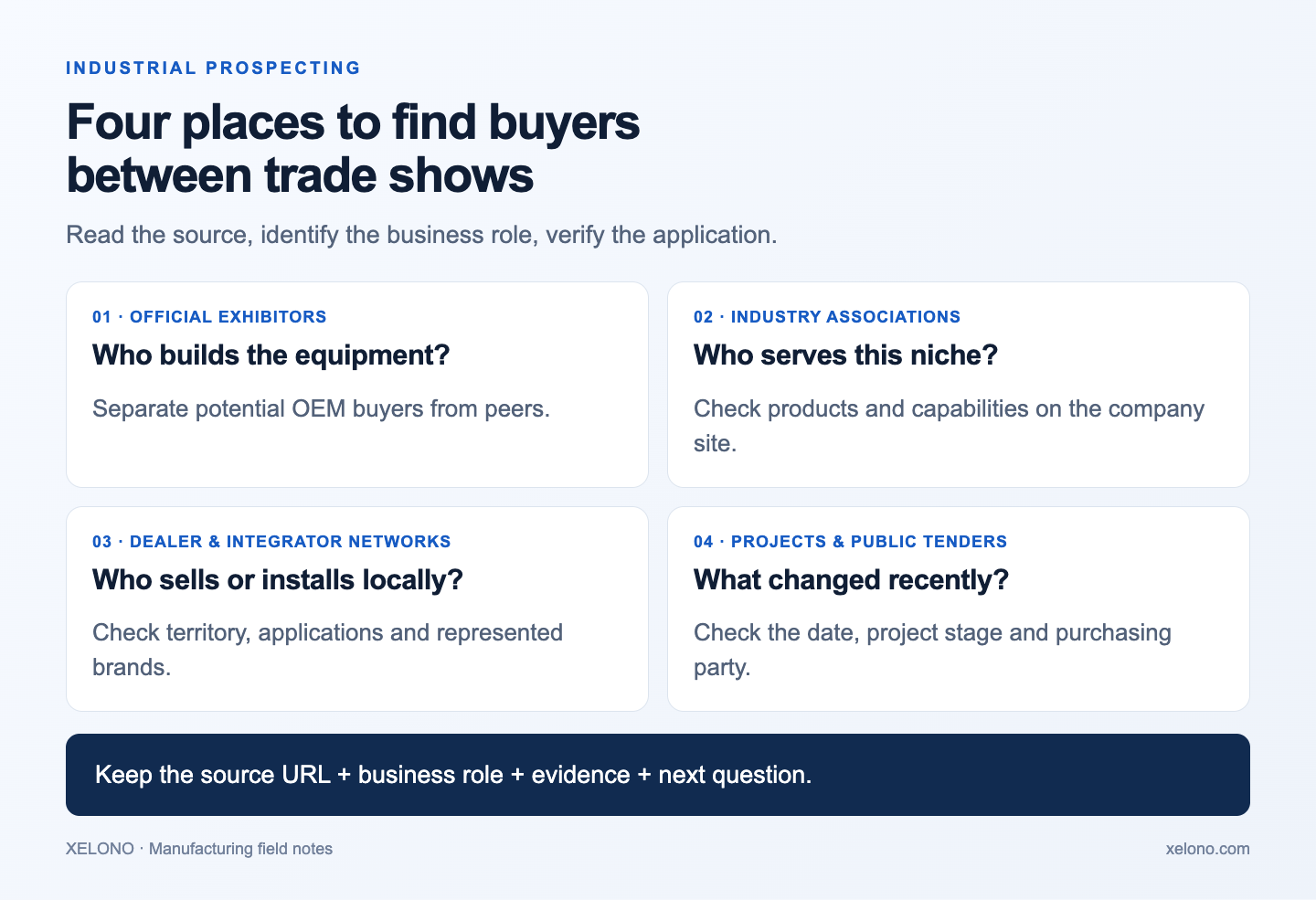
To get manufacturing leads without trade shows, search the public places where industrial companies already describe their work. Official exhibitor directories, industry associations, dealer networks and project notices can help you find prospects throughout the year. AI makes the repeated collection and checking easier to sustain.
The critical step is deciding why each company could buy from your factory. A list of exhibitors is not a list of buyers. A machinery builder may buy your components, while the booth next door sells the same components you do.
This is the source-discovery approach we use in HUNT for factories and manufacturers. Here is how to put it to work, including what to check before you call a record a useful lead.
What does manufacturing lead generation cost between trade shows?
Build the comparison from your own expenses. An illustrative overseas exhibition budget might include $8,000 for space and stand construction, $5,000 for shipping and services, $7,000 for travel and accommodation, and $4,000 in staff time. That is $24,000 for one event, or $48,000 for two similar events. These are planning assumptions, not quoted show prices or an industry average.
If that event produces 40 sales-accepted accounts, the illustrative cost is $600 per accepted account. Calculate the same number for an online prospecting pilot, including software, research, setup and staff review. Do not compare event RFQs with unqualified website names.
A show can still be valuable for demonstrations and buyer meetings. Continuous research fills the weeks around it and gives you a better basis for deciding which events deserve a stand.
Find manufacturing buyers in official exhibitor directories
Start with events serving your downstream application. A supplier of end-of-arm tooling might investigate automation shows. A producer of hygienic pump components might look at process and packaging equipment events.
The HANNOVER MESSE exhibitor and product search is one example of an official discovery source. Use categories and product descriptions to narrow the companies, then follow their official websites to understand their role.
- Choose a buyer category based on your application.
- Collect company identity, official website, source page and event year.
- Separate equipment builders, distributors, end users and competing suppliers.
- Read a relevant product or project page before promoting the account to deeper research.
For a machining factory, a packaging-machine exhibitor could be an OEM prospect. Another machining exhibitor could be a competitor or possible subcontracting partner. Keep those purposes in separate lists. Being at the same show does not establish the same buying relationship.
Directories may load results in batches, hide detail behind a public profile page or repeat sponsored entries. An agent should test the first few batches and compare company identities. When navigation produces the same entries again, it needs to change the collection method or stop that route.
Use industry association directories to find specialist manufacturers
Association listings can reveal focused businesses that broad industry searches miss. PMMI ProSource, for example, organizes packaging and processing suppliers that are members of PMMI. For a component factory, equipment suppliers in those categories may be potential customers.
Search by what the prospect produces, then check its own site. A supplier of conveyor components should distinguish a conveyor OEM from a business that merely resells finished conveyors.
Membership and certification are different facts. An association listing does not prove a company holds a particular quality certificate. If a credential matters, record its issuing body, scope and current status from the relevant source.
Ask the agent to preserve useful classification evidence. “Builds case-packing equipment” with a product-page link is more actionable than a broad label such as “industrial company.” Missing procurement information can be researched later.
Find industrial distributors through dealer and integrator locators
Manufacturer-owned partner directories map regional channels. Dealer locators can uncover resellers and service partners. Integrator locators can identify businesses that combine equipment and components into larger systems.
FANUC America’s authorized integrator directory is a concrete example of the second type. Its relevance depends on what you sell. A gripper or machine-guarding supplier might investigate integrators serving suitable applications, then check their actual projects.
Record the territory, application, represented brands and evidence of installation or service capability. Follow the partner’s own website. Multiple locations may belong to one company, while similarly named businesses may be unrelated.
An existing brand relationship can also be a constraint. A distributor may have an exclusive arrangement or no interest in adding your category. Treat channel fit as a question to establish, not an automatic sales opportunity.
For machinery exporters, PMMI’s sales agent directory offers another starting point for investigating sales agents and distributors. Keep representation prospects separate from factories buying equipment for their own production.
Use tenders and factory expansion news as manufacturing buying signals
A company fits your market all year. A project may explain why this month deserves attention. Search public procurement notices, company announcements and named project updates for specific applications and dates.
The EU’s TED search tools allow searches across procurement notices, including different notice types. Distinguish an open opportunity from an award announcement. A contract already awarded should not be described as an open tender.
For each signal, save the project owner, location, publication date, current stage, relevant equipment scope and the company likely to make the purchasing decision. That last party might be a system integrator or contractor rather than the plant owner.
A new food-processing facility could be relevant to a hygienic pump supplier. The announcement alone does not confirm pump quantities, preferred brands or an active RFQ. Use it to decide what to research next.
How AI turns public industrial sources into a continuous prospecting workflow
The hard part is maintaining a useful search after the easy first results. In HUNT, the discovery stage, T0, has a supervisor coordinating four workers. They can investigate public sources in parallel while the supervisor adjusts assignments using the results.
Suppose an exhibitor directory returns 200 entries, but most are component vendors like you. The supervisor can switch to equipment-builder categories. If a regional directory produces fewer entries but more plausible buyers, it can put more effort there. If records lack official websites, the workers can research those separately.
This is a repeated plan, act, check and adjust cycle. It handles collection problems and business-selection problems together. The agent can inspect a difficult public page, try a supported way of reading it, check the output and retain useful progress. Access restrictions and unavailable information still limit what can be collected.
Use public information through permitted access methods, respect site limits and prefer an official feed or export where available. The source should remain traceable in the final company record.
What to keep for each prospect
Company and official website · buyer role · relevant product or project · source URL and date · unresolved fit question · next research action.
How to start finding manufacturing leads without an exhibition budget
Pick one product family and one market. Write down which companies buy, incorporate or distribute that product. Then choose two complementary sources, collect a small batch and ask a salesperson to classify the results.
Measure new relevant companies per reviewed batch. Merge clear duplicates, retain the best evidence and record why rejected companies do not fit. Use those reasons to improve the next search before adding more sources.
Once the company list is useful, connect it to research and outreach. Our manufacturing AI lead generation guide covers the complete process, while the technical cold email guide shows how to turn an account match into an individual message.
See how HUNT applies this workflow to your manufacturing business. The starting point is your factory’s capabilities and the type of buyer you want to reach.