Factories & Manufacturers
AI Lead Generation for Manufacturing: A Practical Guide
AI lead generation for manufacturing works best when it connects what your factory can actually make with what a potential buyer actually builds. Start with your processes, materials, tolerances and delivery constraints. Use those facts to find companies, check technical fit and write a relevant first email.
For factories and manufacturers selling components, machinery or contract production, a company name is only the beginning. The useful output is a business with a plausible application for your product, evidence you can inspect and a sensible next step for your sales team.
This guide follows that work from the factory capability sheet to the first buyer conversation. It is also the workflow behind our AI prospecting and outreach agent for manufacturers, HUNT.
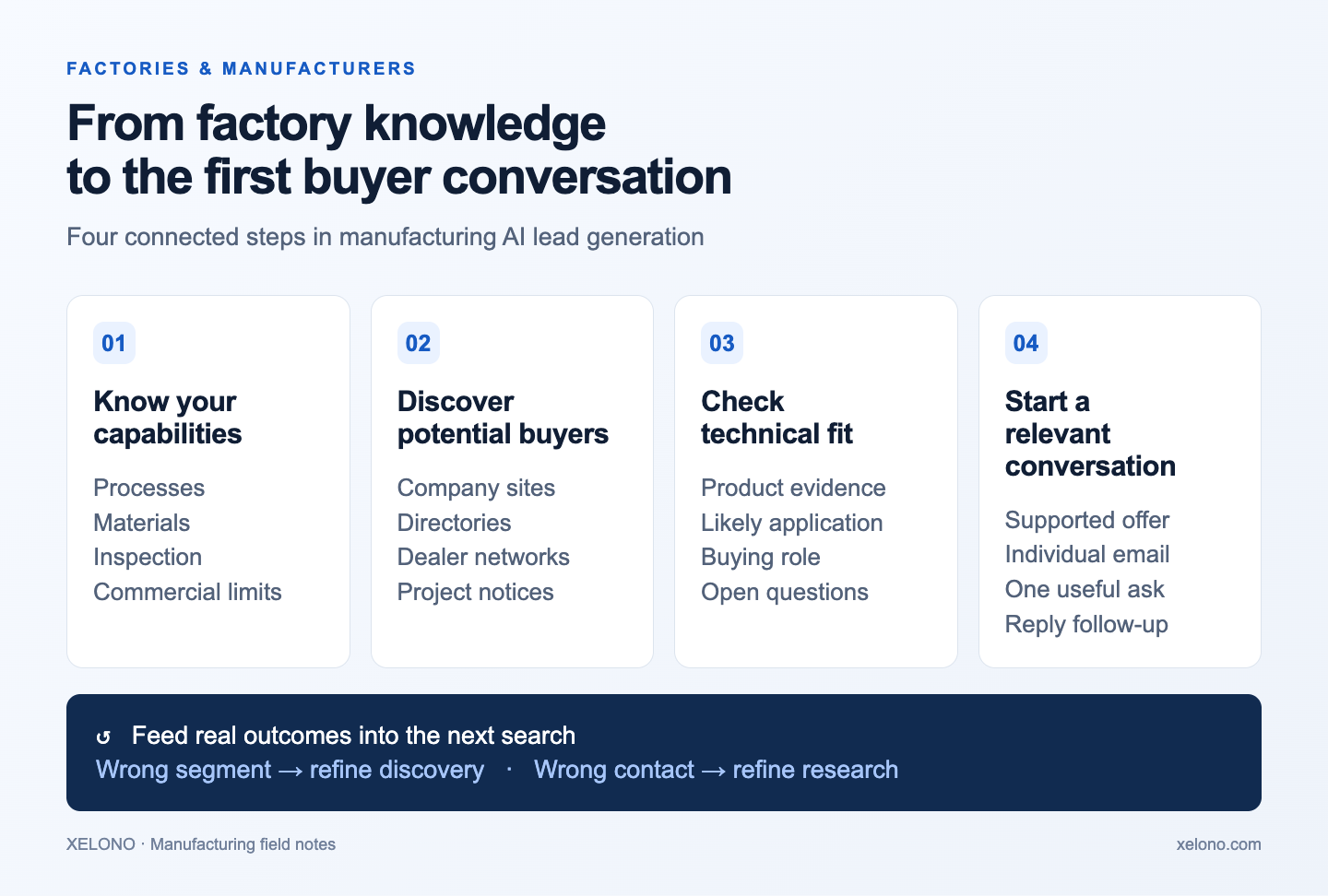
Why AI lead generation for manufacturing needs technical buyer qualification
A software demo can often show the product working immediately. An industrial sale may require a drawing review, sample approval, supplier onboarding and agreement on production capacity before a purchase order is possible. For a capital project planned over six to eighteen months, your first email might arrive long before procurement opens an RFQ. That range is a planning example, not an average for every manufacturing sale.
Different people assess different risks. Engineering checks whether a component works in the assembly. Procurement checks supply terms and vendor eligibility. Quality checks traceability and inspection. A plant manager considers installation, maintenance and downtime. A qualified account can still be the wrong audience for a particular message.
Capability matching is also how formal supplier discovery works. NIST MEP’s Supplier Scouting service searches for manufacturers against specific supply needs and capabilities. Your outbound process should make the same connection in the opposite direction, from your capability to a buyer’s likely application.
Consider a machine shop machining stainless steel valve bodies. “Manufacturers in Germany” is a weak starting point. Valve OEMs serving process equipment are a more useful segment. Yet a valve OEM may make every body in-house. That is a question to investigate, not a reason to claim you have found a confirmed buyer.
Step 1. Build a factory knowledge base for AI prospecting
A company brochure usually describes ambition. An AI agent needs the operating facts a sales engineer would use to accept or reject an inquiry. Give each fact a source document, an owner and a review date so an old capability claim does not silently become a new promise.
| Knowledge to supply | What the AI needs to distinguish |
|---|---|
| Processes and equipment | Processes performed in-house, subcontracted operations and work you decline. |
| Materials and part envelope | Supported grades, part sizes and restrictions on geometry or processing. |
| Tolerances and inspection | Demonstrated capability under stated conditions, rather than a blanket tolerance for every part. |
| Certifications and documentation | The certified entity, scope, validity and documents available to a buyer. |
| Commercial constraints | Viable order sizes, tooling needs, sample policy, delivery regions and lead-time conditions. |
| Applications and cases | Work you can substantiate and customer references you have permission to disclose. |
Then add a short buyer brief. For the valve-body supplier, it could target process-valve OEMs in two countries, keep distributors as a separate segment and exclude machining competitors from the initial campaign. Record why each segment might buy. Leave unconfirmed outsourcing requirements as unknown.
This is where useful personalization starts. If the knowledge base says a process requires a drawing review, the agent should preserve that condition in its outreach. It should not turn a successful previous job into an unconditional promise about the next one.
Step 2. Find manufacturing buyers across multiple public sources
Search for the equipment, assemblies and applications that use your product. A component supplier may find better prospects among machine builders than among companies using the component’s own name in their business description.
Company product pages, official exhibitor directories, association listings and regional dealer networks reveal different parts of the market. Public tenders and plant announcements add timing information. Our guide to finding manufacturing leads without trade shows explains how to work through those sources and separate buyers from peers.
Collection needs a feedback loop. Test a small source sample. Check whether it produces new businesses, whether their websites can be identified and whether the records match the brief. If a directory mostly returns competitors, change the category or move to the next source. If a page loads more results dynamically, verify that the next batch contains new entries before expanding the collection.
In HUNT, this first discovery stage is called T0. An AI supervisor coordinates four workers, reviews their results and adjusts where they look next. It can respond to incomplete records, repeated results and difficult public directories instead of repeating the same search indefinitely. Our earlier walkthrough explains how AI finds potential customers around the clock.
Discovery is an initial screen. It should preserve promising companies with unanswered questions for deeper research, while keeping duplicates and obvious mismatches from inflating the results.
Step 3. Use AI to research technical fit and industrial buying roles
Once a company looks relevant, open its own product, application and project pages. A directory description gets you to the door. The company’s current business tells you whether the opportunity deserves another hour.
For each account, build a short evidence record with four fields.
- Observed business. What the company explicitly says it makes, installs, distributes or operates, with the source URL.
- Possible application. Where your capability could fit, clearly identified as an inference when the buyer has not confirmed it.
- Technical or commercial gap. The material, drawing, supplier approval, quantity or purchasing arrangement still unknown.
- Next buying role. The function most likely to resolve that question, with a verified person or business contact where available.
A photo of a stainless assembly can suggest a relevant application. It cannot establish the alloy, pressure rating or purchasing specification. Read the accompanying product text and available documentation before putting a technical claim in an email.
Keep parent companies, regional subsidiaries and operating sites distinct. A group-level procurement title does not prove that person buys for the plant you researched. Likewise, a valid email address proves reachability more readily than buying authority.
HUNT’s research stage uses the company knowledge and prospect evidence to investigate those connections. An unresolved detail stays a research question rather than being filled in with plausible-sounding text.
Step 4. Generate personalized manufacturing outreach from verified facts
A useful first email contains a reason for contacting this company, one supported capability and a small question. For a valve OEM, the opening might refer to its published process-valve range. The offer might concern machined bodies in a documented material. The question might ask whether the team evaluates external machining suppliers for that range.
That gives procurement or engineering something concrete to respond to. An unsupported promise to cut cost by 30% creates another claim they would have to investigate.
The agent should check both sides of the message before release. Does the buyer page support the observation? Does your knowledge base support the capability? Is an application hypothesis presented as a question? Is the recipient relevant to that discussion? See the manufacturing cold email example for a complete before-and-after comparison.
With sending configured, HUNT can research an account, compose and automatically review its individual first email, then send within the configured limits. Your sales team handles replies, technical discussions and negotiation. That division lets the agent continue discovery while people work on live commercial conversations.
How to measure an AI manufacturing lead generation pilot
Start with one product family, one buyer role and one or two markets. Use a sample your sales engineer can inspect. Twenty to fifty accounts is a practical starting choice for review, not a statistically conclusive benchmark.
Keep the stages visible. Count unique companies discovered, accounts with supported application fit, relevant contacts found, messages delivered, positive replies, technical discussions and RFQs separately. Otherwise, a large discovery count can conceal a shortage of reachable buyers.
A real discovery measurement. In a production run covering November 2–4, 2026, HUNT T0 recorded 10,191 distinct normalized website domains associated with initially screened potential companies over 72 hours. That measures discovery coverage in one run. It does not mean 10,191 verified buyers, contacts or sales.
Calculate cost per sales-accepted account using the full pilot cost, including setup, data, research and review time. Later, calculate cost per qualified conversation or RFQ. Compare channels using the same qualification rule.
Review rejection reasons weekly. “Wrong end market” should change source selection. “Relevant company, wrong contact” should change contact research. “Correct fit, project next year” calls for appropriate follow-up timing. These are different problems and should lead to different adjustments.
How should a small factory start with AI lead generation?
Prepare one accurate capability pack, a few good customer examples and a few examples of work you would reject. Choose a narrow commercial target. Ask the system to show the source behind each proposed match, then inspect what happens when the evidence is incomplete.
If you are choosing software, use our comparison of AI lead generation tools for manufacturers to identify the part of the workflow you need to buy.
To see the full process applied to your factory, explore HUNT’s autonomous buyer discovery, research and outreach workflow. Bring a product family and a target market. The meaningful demonstration is the path from your capabilities to a company worth contacting.