Factories & Manufacturers
Best AI Lead Generation Tools for Manufacturers in 2026
The best AI lead generation tools for manufacturers depend on the job you need done. A contact database, a configurable research platform, an AI sales agent and an industrial sourcing directory solve different problems. Compare them against your factory’s buyer type and technical requirements.
A component factory looking for machinery OEMs needs different evidence from a machine builder selling complete production lines. Start with one segment and ask each shortlisted tool to demonstrate a relevant account, a credible contact and the reason your product fits.
About this comparison. XELONO publishes this guide and builds HUNT, an AI prospecting and outreach agent for manufacturers. This is a documented capability comparison, reviewed November 15, 2026. We have not run a controlled performance test across these vendors. Fit assessments below are our judgments, and should be checked in a pilot.
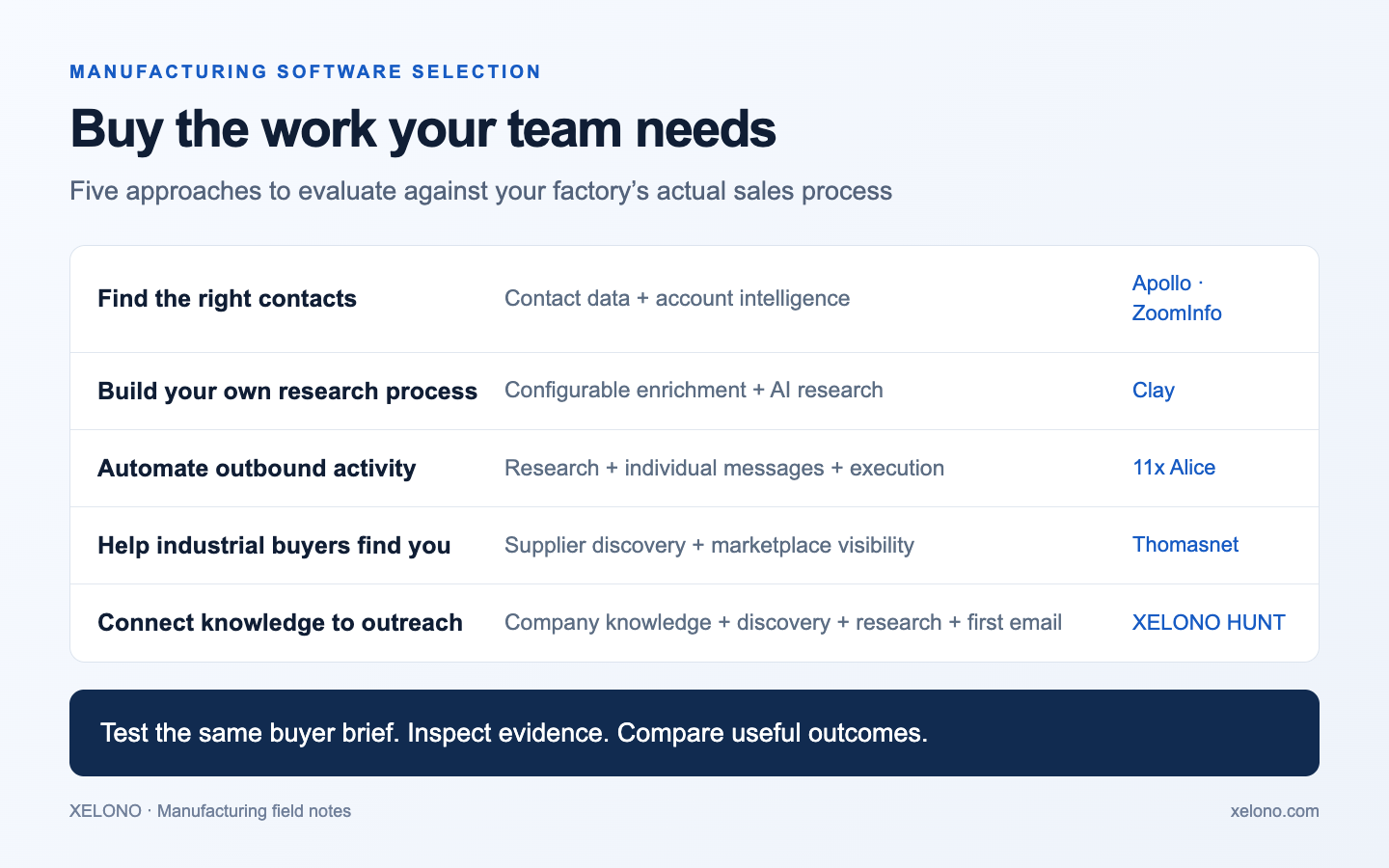
Compare AI lead generation tools for manufacturers by workflow
The table covers five approaches and six named products. It is a shortlist by use case rather than a numerical ranking. Availability and commercial terms should be confirmed with each vendor.
| Approach and product | Useful starting point | What a manufacturer should test |
|---|---|---|
| Contact data + research Apollo | Find companies and people, research accounts and prepare personalized sequences. | Coverage of your exact OEMs, plants and relevant buying roles. Whether research finds the application evidence you need. |
| Account intelligence ZoomInfo | Combine company and contact data with account signals and buying-group context. | Coverage at the correct entity or site, relevance of available signals and package cost for your actual use. |
| Configurable research Clay | Build reusable AI research, qualification and enrichment workflows. | Who will configure, maintain and review the workflow, plus the cost of completed useful records. |
| AI sales agent 11x Alice | Connect research, company knowledge and personalized outbound activity. | Technical claim accuracy, industrial buyer selection, supported source coverage and control over release. |
| Industrial discovery platform Thomasnet | Make supplier capabilities discoverable to industrial buyers, particularly in North America. | Category demand, profile differentiation and the quality of inquiries for your exact capabilities. |
| Connected prospecting workflow XELONO HUNT | Use company knowledge to guide public buyer discovery, account research and individual first outreach. | Fit and contact quality in your niche, setup scope, operating limits and observable business outcomes. |
When a B2B contact database fits manufacturing prospecting
Apollo is worth evaluating when your team needs company and contact discovery with research and outreach in the same environment. Its AI Research documentation describes custom prompts, product context and research fields that can inform qualification and personalized sequences.
For a manufacturer, the practical test is a sample of relevant accounts. Can you find the machinery OEM, the correct regional business and a suitable engineering or sourcing contact? Can the research support a technical match? Do not assume industrial coverage is weak or strong without checking your segment.
ZoomInfo is another option when account intelligence and timing signals matter. Its Signals & Insights documentation describes company and contact signals combined with account, buying-group and CRM context.
Test whether those signals correspond to your sale. A general company change is different from a published equipment project or supplier requirement. Ask what is included in the proposed package and confirm coverage of the operating sites you need. Neither database size nor a broad industry filter establishes procurement fit on its own.
When configurable AI research is useful for a manufacturing sales team
Clay is a candidate for teams that want to design their own research and qualification process. Claygent Builder supports agents for account research, lead scoring, copywriting and persona classification, with business context and documents added to prompts.
That flexibility can suit a manufacturer with an operations owner who knows how to translate a technical sales rule into a repeatable workflow. A conversational builder can reduce the effort of getting started. Someone still needs to own the sources, acceptance criteria, exceptions and maintenance.
Ask for a workflow that reads your capability pack, identifies a relevant product on the buyer’s site and leaves unknown specifications unresolved. Price the completed record, including enrichment and research usage. A low-cost intermediate step is not the same as a low-cost usable prospect.
What to test before buying an AI sales agent for manufacturing
11x Alice should be assessed as more than a template sender. Its personalization documentation describes inputs from external research, a company knowledge base, CRM context and signals, along with review and approval options.
Ask it to demonstrate the manufacturing details that matter to you. Can it distinguish an equipment builder from an end user? Does it keep a conditional machining tolerance conditional? Can you inspect why an account and a particular recipient were selected?
Its published capabilities establish that company context and research are supported. They do not settle how well a particular deployment will qualify your niche. Check the allowed sources, channel behavior, commercial scope and responsibility for keeping product knowledge current before choosing a package.
When an industrial supplier platform belongs in your lead generation mix
Thomasnet is particularly relevant when buyers search for industrial suppliers and capabilities in North America. Its Smart Search guide describes supplier discovery by products, services and capabilities. Thomas also offers supplier profiles and marketing services.
This route lets buyers discover your factory when they are looking for a supplier. It serves a different purpose from an agent that independently searches for new accounts and starts outreach.
Evaluate the categories you would appear in, the capabilities your profile can demonstrate and the inquiries you receive. Ask how paid visibility is measured. Competing profiles make differentiation important, but the platform should not be dismissed as price-only competition without evidence from your market.
When to choose a connected AI prospecting workflow for a factory
XELONO HUNT is designed to connect the factory knowledge, search, research and initial outreach. Its discovery stage uses a supervisor and workers to investigate public sources, review the results and adjust subsequent work. Account research then examines fit and contacts before an individual message is composed.
With sending configured, first outreach can run through automated review and release within set limits. Your team handles the replies and technical selling. Our manufacturing AI lead generation guide explains the workflow in detail.
The tradeoff is that useful setup requires your factory’s actual knowledge and a clear commercial scope. Public information may not reveal outsourcing needs, current suppliers or decision-making authority. HUNT still needs to earn its place with relevant companies, usable contacts and useful conversations. We are not claiming it has outperformed every tool in this guide.
How to compare manufacturing lead generation tools in a fair pilot
Give each candidate the same product brief, target region, buyer definition and exclusion rules. Include examples of a good fit, a competitor and an ambiguous company. Use the same review criteria and account for differences in coverage.
- Account fit. Does the company perform the relevant business activity? Check the original evidence.
- Contact relevance. Is the person at the correct business and plausibly connected to the buying question?
- Technical accuracy. Can you trace every material, process and capability claim to a source?
- Useful completion. How many records reach the stage your sales team actually needs?
- Operating cost. Include setup, subscriptions, data usage, maintenance and review time.
- Commercial outcomes. Track positive replies, technical discussions and RFQs over an appropriate period.
Ask vendors to demonstrate incomplete and ambiguous cases as well as their best examples. A tool that makes uncertainty visible may be more useful than one that fills every field with an unsupported answer.
Which AI lead generation approach should a small manufacturer choose first?
If you already know your target companies and need contacts, start by evaluating a database. If you have an operations specialist and want to own the process, evaluate configurable research. If industrial buyers already search your category, consider a supplier platform. If the bottleneck spans discovery, technical research and first outreach, evaluate an integrated agent against that complete job.
Choose the smallest scope that demonstrates value. To evaluate our approach, see HUNT’s manufacturing prospecting workflow and bring one product family and one buyer segment. Use the same evidence and outcome checks you would apply to any other vendor.