Factories & Manufacturers
AI Cold Email for Manufacturing: Write From Technical Fit
AI cold email for manufacturing works when the message connects a documented factory capability to a real application at the buyer’s company. The AI needs both your technical knowledge and evidence from the prospect’s business before it writes.
A purchased contact list and a fluent writing prompt do not supply that connection. If a campaign gets few replies, inspect the account fit, recipient, technical claim and delivery conditions before asking the AI to produce another subject line.
That is the approach behind HUNT’s research and personalized outreach for manufacturers. This guide shows what belongs in the input, what a useful email looks like and what to measure after it goes out.
Why generic AI cold outreach fails to engage manufacturing buyers
“High quality, competitive prices and excellent service” gives an engineer very little to assess. The sender might manufacture a critical machined component, distribute an unrelated consumable or simply have found the recipient in a database.
Three missing inputs usually make this kind of message generic.
- The factory’s actual capability. The AI has no reliable material, process, dimensional or inspection information to offer.
- The prospect’s application. The research stops at an industry label and never reaches the equipment or product page.
- The recipient’s role. The same message goes to engineering, procurement and general management even though they need different information.
A tool can support detailed research and still produce weak copy if those inputs are missing. The failure is not universal to AI or to general-purpose platforms. It appears when the system writes beyond what it knows.
Low replies also have other causes. A relevant company may have no current sourcing need. The contact may be wrong, or the message may not be delivered. Treat these as separate checks rather than assuming every unanswered email is a writing problem.
What to put in a manufacturing knowledge base before writing cold emails
Supply the facts you would allow a salesperson to send without inventing a promise. Include supported processes, materials, part sizes, inspection methods, sample conditions and approved application examples. Mark claims that require a drawing review or another technical check.
For illustration, imagine a factory with a documented capability to machine 316L stainless steel components and provide dimensional inspection reports. It still cannot promise that an unseen part meets every tolerance on a future drawing. Keep the material capability and drawing-specific acceptance separate.
Store certifications with their scope and validity. Store lead times with their conditions. If customer names are confidential, prepare an approved anonymous case rather than allowing the agent to invent a testimonial.
The factory knowledge base checklist covers the broader setup. For an individual email, retrieve only the facts relevant to that buyer and application.
How to personalize a manufacturing cold email using buyer evidence
Open the prospect’s product and application pages. Record the product family, the stated application and the source. Then ask where your capability could reasonably fit and what remains unconfirmed.
A public page describing hygienic filling systems can support an observation about that product range. A production-line photo may help you understand the context, but it does not establish the alloy, dimensions or supplier of a pictured component. Do not turn visual guesses into technical specifications.
Before writing, build a short three-part brief.
| Input | Illustrative record |
|---|---|
| Buyer fact | The company’s product page describes hygienic filling systems. |
| Supplier fact | The factory’s approved capability sheet includes 316L machining and dimensional inspection reports. |
| Open question | Does this buyer source relevant machined components externally? |
The first two inputs support a specific offer. The third becomes a question. This is a better starting point than telling the prospect that you already know it needs a new supplier.
Manufacturing cold email example before and after technical research
The messages below are fictional teaching examples. The companies, recipient and capabilities are illustrative, and no reply-rate improvement is claimed.
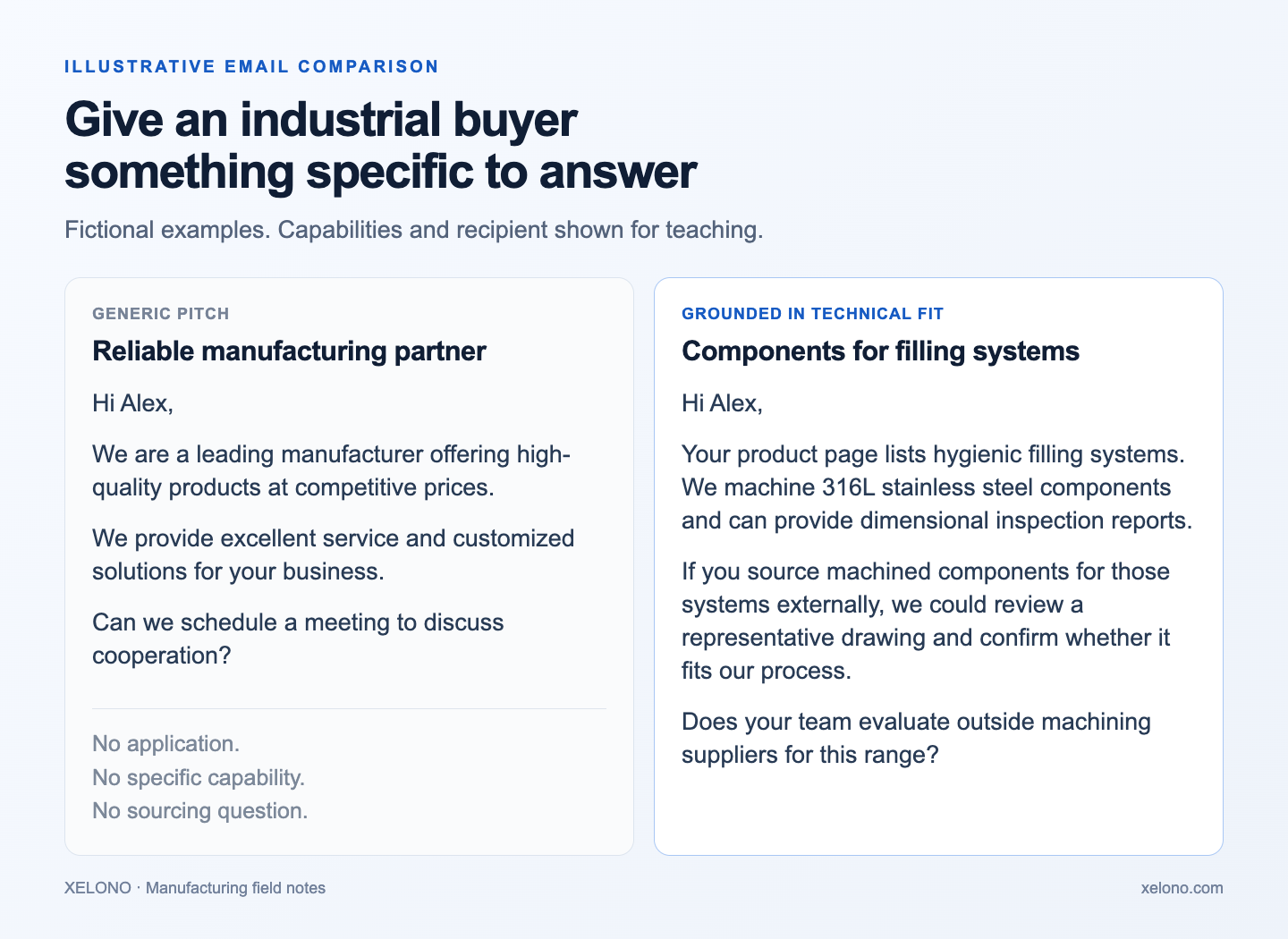
Before — generic manufacturing sales email
Subject: Reliable manufacturing partner
Hi Alex,
We are a leading manufacturer offering high-quality products at competitive prices. We provide excellent service and customized solutions for your business. Can we schedule a meeting to discuss cooperation?
After — email grounded in technical fit
Subject: Components for filling systems
Hi Alex,
Your product page lists hygienic filling systems. We machine 316L stainless steel components and can provide dimensional inspection reports.
If you source machined components for those systems externally, we could review a representative drawing and confirm whether it fits our process.
Does your team evaluate outside machining suppliers for this range?
The second message avoids guessing the buyer’s component specification or current supplier. It offers a drawing review as a possible next step, then asks whether the sourcing relationship exists. A real email also needs the sender’s identity, business details and an appropriate way to decline further contact.
How to adapt industrial cold emails for procurement and engineering
The underlying evidence can be the same while the question changes. Send the question to the person whose work it concerns.
- Engineering. Ask whether a relevant application or drawing is worth evaluating. Offer the specific technical information you can substantiate.
- Procurement. Ask whether external suppliers are considered for that category and what vendor requirements apply.
- Plant or operations management. Focus on an observed production or maintenance application. Do not assume purchasing authority or invent a downtime problem.
When the role is uncertain, research further or use an appropriate business inquiry route. Email verification and job-title matching cannot by themselves establish who controls a particular sourcing decision.
How to automate manufacturing outreach while keeping technical claims accurate
The workflow needs an evidence check between composition and sending. Match the buyer observation to its source. Match the supplier claim to the knowledge base. Check that conditional capabilities remain conditional and that the question makes sense for the selected recipient.
HUNT connects these stages. Discovery finds potential companies. Research investigates the application and contact. The outreach stage creates a message for that account and runs an automated review against the available evidence. With sending configured, routine first emails can be released automatically within the set limits. Salespeople take over replies and commercial discussions.
Missing evidence should lead to more research, a narrower statement or deferral. It should not be repaired by adding more confident adjectives.
Delivery is a separate part of the work. Authenticate the sending domain, monitor bounces and complaints, maintain suppression records and honor opt-outs. For messages to personal Gmail accounts, Google’s sender guidelines set authentication and other requirements, with additional conditions for bulk senders. Follow the rules that apply to your provider, audience and destination market.
How to measure AI cold email results for a manufacturing company
Count positive replies and useful commercial outcomes separately from total replies. “Please contact our sourcing engineer” is different from an out-of-office response. A drawing request, supplier-registration invitation or technical discussion can be meaningful long before a purchase order.
Use delivered messages as the denominator when reporting a reply rate. Record bounced messages separately. Compare similar buyer segments over the same period, and change one meaningful input at a time so you can interpret the result.
If replies show that companies make the work in-house, refine the buyer hypothesis. If they ask for a certification you lack, refine qualification. If they ask for details already in your capability pack, improve the relevant proof offered in the message.
For a factory, that feedback is more useful than simply increasing send volume. If your account list needs work first, start with public sources for manufacturing prospects. To connect discovery, research and individual outreach, see how HUNT works with your company knowledge.